YAMI KAWAII- SICK BUT CUTE
"Japan" is famed not just for its order and discipline in every aspect but also for its unique culture and fashion. The burgeoning prevalence of Japanese pop culture has long attracted young people from around the world for quite a long time.
Whether they are gigantic robots, saucer-eyed schoolgirls, or the aesthetic supremacy of Hello Kitty, Japanese pop culture is a phenomenon that has reached far around the globe. The streets of Harajuku are the hub of some of the world's most unique and crazed fashion trends. From Decora to Gothic Lolita, Gyaru to cutesy fairy kei and punk rock clothes are all part of Harajuku Street fashion.
But little is indeed known that in Japan rigidity informs everything, starting from the customs to the way of dressing up. Because standing out from the crowd is not what every person strives for. Especially the old folks of the country. But for the verdant youth, style is defined by challenging standards and rebelling against old social conformities.
Therefore, a new look "YAMI KAWAII" an emerging Harajuku subculture, is now challenging one of Japan's biggest and deepest taboos: depression and mental illness.
WHAT DOES YAMI KAWAII MEAN?
YUME KAWAII
YAMI KAWAII
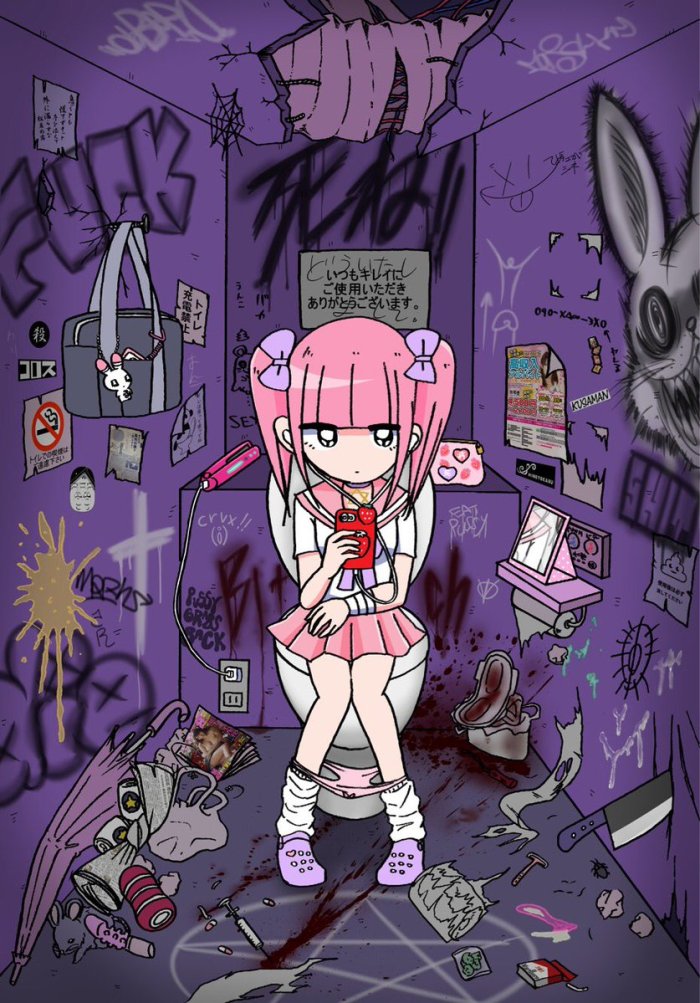
"Kawaii" means a simple, blissful feeling of cuteness. When we express kawaii, we merely express our desire to call upon other people purely and innocently. The word Yume kawaii is sweet like a dream while Yami kawaii is when Yume becomes dark. Yami kawaii adds contrasting elements to the traditional Yume kawaii style by adding darker themes to it and becoming anti-kawaii. In layman's terms, the darker side of Harajuku style is what we may call Yami kawaii which in a literal sense stands for "sick but cute".
STYLE
Yume kawaii is predominantly pastel colors and it's somewhat soft but if we look at Yami kawaii the concept has darker elements like phantom black and motifs such as medical, suicidal or more grotesque themes are delivered as well. Yami kawaii aesthetic represents all the insecurities and negative feelings that people have, whether it's sadness, obscurity, or illness, and then reformats them in a way that makes it appealing, loving, and cute.
One can facilely notice the darker elements among all the soft and bright pastels. The style includes tees spelling out "cute but kill you". The bandages around the girl's wrists and the droplet hanging off the syringe make this style all the more regaling yet creepy. The style additionally utilizes the miniatures of the implements used for suicide. Hanging ropes, knives, and blades, etc. are some commonly found elements, to integrate more into its already dark and harrowing theme.
ORIGIN

The word Yami kawaii came to light and gained fame through the works of the illustrator Ezaki Bisuko, who introduced us to “Menhera- chan” code-designated “the wrist cut warrior” a character that betokens mental health. Ezaki engendered Menhera-chan in the course of his high school days when he was preparing for the university entrance exam in his senior year. Later it turned out that during those times he was perpetually being bullied by others. Also, he was struggling with the exam, part-time job, his family, and school. Nothing was going his way.
Being fond of doodling he used to draw Menhera-chan instead of preparing for the entrance exam. He used Menhera-chan as a portal to elude the harsh reality he was living in. Afterward, around 2013 he started taking photos of his creation and posting them on Twitter, and to his amusement, he got some authentically good responses and positive feedback. And so commenced his vocation as an illustrator.
According to the manga “Momoka Sakurai,” the protagonist of the story is a run-of-the-mill high school student who is conventionally mute and keeps to herself. She is additionally dejected and had a rough childhood. One day Momoka is assailed by her jealous classmates for being popular. Following the incident her stuffed bunny verbalizes out, telling her to spill blood on it. She follows the instructions curiously by cutting her wrist. When she does, the bunny magically transforms her into Menhera-chan who is equipped with a magical box cutter that vanquishes the diabolic forces.
The dainty aesthetics and unique storyline have captivated a considerable amount of people throughout Japan and beyond, leading Yami kawaii to become a mainstream Harajuku subculture.
A SAFE ESCAPISM
The Yami kawaii trend is cultivating expeditiously among the youth and the reason for the same is the ascending suicide rates in Japan. But because mental health and suicide are still largely considered taboo subjects in Japanese culture, the Yami kawaii trend is emerging as an impeccable way for people struggling with these sentiments to express themselves more liberatingly and fashionably. For young fashion enthusiasts, it's like breaking a long hush of mental oppression because for them this look seems empowering and cool.
For most people, Yami kawaii is just another fashion trend, but they don't realize that for people with distress and severe mental health issues, it is a unique adaption of its kind, because for them it is a door to escape the harsh social realities. It's like a home they've wanted for centuries, a perfect world where they're not afraid of being judged or abandoned for being different. Not only that, but Yami kawaii also offers depressed young people a community where they feel no restrictions to talk about their art, clothes, and raw emotions as it brings together like-minded people under the same umbrella and complex emotions. Now, if we take a closer look, Yami kawaii can be considered a rejuvenating therapy for those downcast young minds.
So, celebrate your diversity because "the more you can tap into your real self, the more you can experience your full potential, your real magic."
-BHUMIKA TIWARI
0 Comments Add a Comment?